

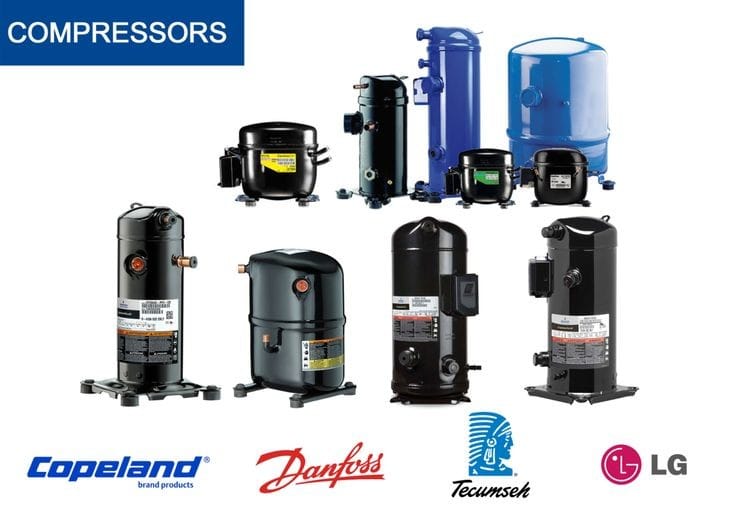
Types of Refrigeration Compressors: Which One Should You Choose?
Refrigeration compressors are one of the most important components in any refrigeration or cold room system. They circulate refrigerant through the system, allowing heat to be removed from a cold room, freezer, storage facility, or other temperature-controlled environment.
Choosing the right refrigeration compressor can affect cooling performance, energy consumption, system reliability, maintenance requirements, and the overall operating cost of your refrigeration system.
In Kenya, refrigeration compressors are used in cold rooms, food processing facilities, supermarkets, restaurants, hotels, agriculture, horticultural storage, pharmaceutical storage, poultry facilities, and other temperature-controlled applications.
In this guide, we explain the main types of refrigeration compressors, how they work, their advantages and disadvantages, and how to choose the right compressor for your application.
What Is a Refrigeration Compressor?
A refrigeration compressor is the component that circulates refrigerant around a refrigeration system. It receives low-pressure refrigerant vapour from the evaporator and compresses it into a high-pressure, high-temperature vapour.
The compressed refrigerant then moves to the condenser, where heat is released before the refrigerant continues through the rest of the refrigeration cycle.
A typical refrigeration system consists of several important components, including the compressor, condenser, expansion device and evaporator. Understanding these components is essential when selecting refrigeration equipment.
For a better understanding of how these components work together, read our guide to the components of a cold room setup.
How Does a Refrigeration Compressor Work?
The refrigeration compressor operates continuously during the cooling cycle to move refrigerant through the system.
The basic process is:
- The evaporator absorbs heat from the cold room or refrigerated space.
- Low-pressure refrigerant vapour travels from the evaporator to the compressor.
- The compressor compresses the refrigerant, increasing its pressure and temperature.
- High-pressure refrigerant travels to the condenser.
- The condenser releases heat to the surrounding environment.
- The refrigerant passes through an expansion device, reducing its pressure and temperature.
- The cold refrigerant returns to the evaporator and absorbs heat again.
This continuous refrigeration cycle allows cold rooms and other refrigerated spaces to maintain the required temperature.
Main Types of Refrigeration Compressors
There are several types of compressors used in refrigeration systems. The most common include:
- Reciprocating compressors
- Screw compressors
- Scroll compressors
- Centrifugal compressors
- Rotary compressors
The best option depends on the required cooling capacity, application, refrigerant, operating temperature, system design, energy requirements and installation conditions.
1. Reciprocating Refrigeration Compressors
Reciprocating compressors use pistons and cylinders to compress refrigerant. As the piston moves inside the cylinder, refrigerant is drawn into the cylinder, compressed and then discharged at a higher pressure.
They are widely used in refrigeration because they are available in different sizes and can be suitable for both small and larger refrigeration applications.
Advantages of reciprocating compressors
- Suitable for a wide range of cooling capacities
- Available in different configurations and sizes
- Reliable when correctly selected and maintained
- Suitable for low-temperature applications
- Commonly available for cold room refrigeration systems
- Can be used with different refrigeration system designs
Applications
Reciprocating compressors can be used in:
- Cold rooms
- Freezer rooms
- Food storage facilities
- Supermarkets
- Restaurants and hotels
- Agricultural storage
- Food processing facilities
- Industrial refrigeration systems
For customers looking for individual refrigeration components, our range of refrigeration products includes products such as Bitzer compressors.
2. Screw Refrigeration Compressors
Screw compressors use rotating screws to compress refrigerant. They are particularly useful for applications requiring continuous operation and relatively high refrigeration capacity.
Screw compressors are commonly found in industrial refrigeration installations where large cooling loads need to be handled efficiently.
Advantages of screw compressors
- Suitable for high-capacity refrigeration systems
- Designed for continuous operation
- Good efficiency at suitable operating conditions
- Smooth and consistent compression
- Suitable for industrial applications
Applications
Screw compressors can be considered for:
- Large cold storage facilities
- Food processing plants
- Industrial refrigeration
- Large warehouses
- Manufacturing facilities
- Central refrigeration systems
For large installations, compressor selection should be based on the complete refrigeration system design rather than compressor capacity alone.
3. Scroll Refrigeration Compressors
Scroll compressors use two spiral-shaped components to compress refrigerant. One scroll remains stationary while the other moves, gradually compressing the refrigerant toward the centre.
Scroll compressors are known for their compact design and relatively quiet operation.
Advantages of scroll compressors
- Compact construction
- Low vibration
- Quiet operation
- Efficient operation in suitable applications
- Fewer moving parts than some conventional compressor designs
Scroll compressors can be suitable for smaller refrigeration and air conditioning applications where compact equipment and reliable operation are important.
4. Centrifugal Refrigeration Compressors
Centrifugal compressors use high-speed rotating impellers to increase refrigerant pressure. They are generally designed for large-capacity refrigeration systems.
They are more commonly associated with large industrial and central cooling applications rather than small cold rooms.
Advantages
- Suitable for large cooling capacities
- Can provide efficient operation at suitable loads
- Suitable for large central refrigeration systems
- Designed for applications requiring substantial cooling capacity
Because of their size and operating requirements, centrifugal compressors require careful system design and professional installation.
5. Rotary Refrigeration Compressors
Rotary compressors use rotating components to compress refrigerant. They are commonly found in smaller refrigeration and air conditioning equipment.
Their compact size makes them useful where installation space is limited.
They may be suitable for smaller cooling applications, depending on the required capacity and operating conditions.
Hermetic, Semi-Hermetic and Open-Type Compressors
Apart from the compression mechanism, refrigeration compressors can also be classified according to their construction.
Hermetic Compressors
In a hermetic compressor, the motor and compressor mechanism are enclosed within the same sealed housing.
Hermetic compressors are commonly used in smaller refrigeration and air conditioning equipment.
Benefits
- Compact design
- Sealed construction
- Reduced risk of refrigerant leakage through the shaft
- Suitable for many small refrigeration applications
Semi-Hermetic Compressors
Semi-hermetic compressors also contain the motor and compressor within the same housing, but the housing can be opened for servicing.
This makes them useful in applications where maintenance and component replacement are important considerations.
Semi-hermetic compressors are widely used in refrigeration systems, including cold rooms and other commercial and industrial applications.
Open-Type Compressors
Open compressors have a separate motor and compressor connected through a shaft or coupling.
They are commonly considered for larger refrigeration systems where serviceability, flexibility and high capacity are important.
How to Choose the Right Refrigeration Compressor
Choosing a refrigeration compressor should not be based on price or horsepower alone.
Several factors should be considered before selecting a compressor.
1. Required Cooling Capacity
The first consideration is the amount of cooling required.
A compressor that is too small may struggle to maintain the required temperature, while an oversized compressor may result in inefficient operation and unnecessary equipment costs.
The refrigeration load should be calculated before selecting the compressor.
2. Required Temperature
The required room temperature is another important factor.
A compressor designed for a medium-temperature application may not be suitable for a low-temperature freezer application.
For example, a compressor used for chilled products may have different operating requirements from one used for frozen food storage.
3. Refrigerant Type
The compressor must be compatible with the refrigerant used by the refrigeration system.
Always confirm refrigerant compatibility before purchasing or replacing a compressor.
4. Power Supply
Electrical requirements should also be considered.
Depending on the installation, the compressor may require single-phase or three-phase power. Voltage, frequency, starting current and electrical protection should be checked before installation.
5. Operating Environment
The location of the refrigeration system can affect compressor performance.
High ambient temperatures, poor ventilation and inadequate condenser airflow can increase operating pressure and reduce system efficiency.
This is particularly important for refrigeration installations in warm climates such as Kenya.
6. Energy Efficiency
Energy consumption is an important consideration because refrigeration systems may operate for many hours every day.
A properly sized and correctly installed compressor can help reduce unnecessary energy consumption and operating costs.
7. Availability of Spare Parts and Service
When selecting refrigeration equipment, consider the availability of replacement parts, technical support and maintenance services.
Choosing a commonly supported compressor brand can make future maintenance easier.
Choosing a Compressor for a Cold Room
Cold room compressor selection depends on several factors, including:
- Cold room size
- Product type
- Required storage temperature
- Product loading temperature
- Quantity of products stored
- Daily product turnover
- Ambient temperature
- Insulation quality
- Evaporator capacity
- Condenser capacity
- Refrigerant type
- Required operating hours
For example, a small chilled-food cold room will have different compressor requirements from a large freezer room storing frozen products.
The compressor should therefore be selected as part of a complete refrigeration system.
If you are planning a new cold room, upgrading an existing installation or replacing refrigeration equipment, professional system design can help ensure that the compressor, condenser, evaporator and expansion device are properly matched.
Refrigeration Compressors for Applications in Kenya
Refrigeration compressors are used throughout Kenya in a wide range of industries.
Common applications include:
Agriculture and Horticulture
Cold storage helps maintain product quality after harvesting. Refrigeration systems are commonly required for fruits, vegetables, flowers and other temperature-sensitive agricultural products.
Food Storage
Restaurants, hotels, supermarkets, butcheries and food distributors may use cold rooms and refrigeration equipment to store perishable products safely.
Poultry and Meat
Temperature-controlled storage is important for poultry, meat and other perishable products.
Fisheries
Fish and other seafood products require reliable low-temperature storage to maintain quality during handling and distribution.
Pharmaceutical and Temperature-Sensitive Products
Some pharmaceutical and temperature-sensitive products require controlled storage conditions. Refrigeration systems for these applications should be carefully designed and monitored.
Industrial Applications
Large-scale manufacturing and processing facilities may require industrial refrigeration systems with higher cooling capacities.
Why Correct Compressor Selection Matters
Installing the wrong compressor can cause a number of problems, including:
- Poor cooling performance
- Excessive energy consumption
- Frequent compressor cycling
- High operating pressure
- Compressor overheating
- Increased maintenance requirements
- Shorter equipment life
- Difficulty maintaining the required room temperature
Correct sizing is therefore essential.
The compressor should be matched to the evaporator, condenser, expansion device, refrigerant and expected refrigeration load.
Refrigeration Compressor Maintenance
Regular maintenance can help extend compressor life and improve refrigeration system performance.
Important maintenance practices include:
- Checking refrigerant levels and operating pressures
- Inspecting electrical connections
- Checking compressor oil where applicable
- Cleaning condenser coils
- Ensuring adequate condenser airflow
- Inspecting fans and motors
- Checking for refrigerant leaks
- Monitoring operating temperatures
- Checking unusual vibration or noise
- Inspecting system controls and safety devices
A refrigeration system should also be inspected when cooling performance changes unexpectedly.
Early identification of problems can help prevent more expensive equipment failures.
Refrigeration Compressor Problems
Some common compressor-related problems include:
Compressor Not Starting
Possible causes include electrical faults, defective controls, overload protection, incorrect voltage or a damaged motor.
Compressor Overheating
Overheating can result from high condensing temperatures, inadequate airflow, incorrect refrigerant charge, electrical problems or excessive operating load.
Excessive Noise or Vibration
Unusual noise may indicate mechanical wear, mounting problems, refrigerant issues or other system faults.
Poor Cooling Performance
Poor cooling does not always mean that the compressor itself is faulty. Problems may also originate from the evaporator, condenser, expansion device, refrigerant charge, insulation or controls.
A complete system diagnosis is therefore recommended.
Frequently Asked Questions About Refrigeration Compressors
What is the best refrigeration compressor?
There is no single compressor that is best for every application. The correct choice depends on cooling capacity, temperature requirements, refrigerant, electrical supply, operating conditions and system design.
Which compressor is best for a cold room?
Reciprocating and other compressor types can be used for cold rooms depending on the size, temperature and refrigeration load. The compressor should be selected based on a proper refrigeration load calculation.
Are Bitzer compressors suitable for cold rooms?
Bitzer compressors are widely used in refrigeration applications and can be suitable for cold rooms when the correct model and operating configuration are selected for the application.
You can view our available
for more information.
How long does a refrigeration compressor last?
Compressor service life varies depending on the equipment, operating conditions, maintenance, installation quality and frequency of operation. Proper installation and regular maintenance can help extend service life.
Can I replace a refrigeration compressor with a different model?
A replacement compressor should not be selected based on physical size or horsepower alone. Capacity, refrigerant, operating temperature, voltage, displacement and other technical specifications must be checked to ensure compatibility.
Get the Right Refrigeration Solution
Selecting the right refrigeration compressor is an important part of designing an efficient and reliable refrigeration system. Whether you need a compressor for a small cold room, freezer, food storage facility, agricultural application or industrial refrigeration system, the equipment should be correctly matched to the refrigeration load and operating conditions.
The Cold Room Kahuna provides refrigeration equipment and cold room solutions for customers in Kenya and the wider East African market.
From refrigeration compressors and cold room components to complete refrigeration installations, choosing the correct equipment can help improve cooling performance, reliability and operating efficiency.
If you are looking for refrigeration compressors, cold room equipment or professional refrigeration solutions in Kenya, explore our The Cold Room Kahuna website or contact our team to discuss your refrigeration requirements.