

How to Reduce Heat Stress in Warehouses, Poultry Houses, Greenhouses and Industrial Buildings
Excessive heat can affect productivity, workplace comfort, livestock welfare and crop growth. In warehouses, poultry houses, greenhouses, cow sheds, boiler rooms and commercial kitchens, poor air circulation can allow heat and humidity to build up, creating uncomfortable and potentially hazardous working conditions.
The right industrial ventilation system can help remove accumulated hot air, improve air movement and support better environmental conditions. For businesses and farms in Kenya, Tanzania and South Sudan, choosing suitable industrial fans is an important step towards managing heat in demanding environments.
The Cold Room Kahuna supplies industrial fans, centrifugal blowers and ventilation solutions for commercial, agricultural and industrial applications. We help customers identify suitable equipment for their ventilation requirements, with supply and installation options available for projects across Kenya and the wider East African region.
What Causes Heat Stress in Industrial Buildings and Agricultural Facilities?
Heat stress occurs when the body or an animal struggles to lose enough heat to maintain a safe internal temperature. In buildings, excessive temperatures may result from direct sunlight, hot machinery, boilers, cooking equipment, high humidity, inadequate air exchange or insufficient ventilation.
Common causes include:
- Poor airflow and stagnant air inside buildings.
- Heat generated by industrial machinery and production processes.
- Hot roofs and walls exposed to direct sunlight.
- High humidity caused by steam, moisture or agricultural activities.
- Inadequate removal of hot air from enclosed spaces.
- Insufficient ventilation in livestock housing and greenhouses.
- Poorly designed or undersized ventilation equipment.
Installing an industrial fan can improve air movement, but the solution must match the source of heat and the building’s ventilation requirements. Some applications need general air circulation, while others require hot air to be extracted and replaced with fresh air.
1. How to Reduce Heat Buildup in Warehouses and Factories
Warehouses and factories can become excessively hot, especially when they have large metal roofs, limited ventilation, heat-producing machinery or high ceilings. Workers may experience discomfort, fatigue and reduced productivity, while certain products and equipment may require controlled environmental conditions.
Recommended ventilation solutions
Industrial axial fans: These move relatively large volumes of air and can be suitable for general ventilation, wall-mounted installations and moving air through appropriate openings.
High-volume industrial fans: Depending on the model and installation, these can help improve air movement across large working areas.
Centrifugal blowers: These are useful where air must be pushed through ductwork or systems with greater resistance. The required airflow and static pressure must be considered when selecting the blower.
Roof and wall ventilation: Properly positioned fans and air inlets can help remove accumulated hot air and allow replacement air to enter the building.
Before selecting a fan, consider the warehouse floor area, ceiling height, heat sources, number of workers, available openings and required air changes. A large building may need several strategically positioned fans rather than one powerful unit.
Explore our industrial fans for sale in Kenya for equipment suitable for a range of industrial and commercial ventilation applications.
2. How to Reduce Heat Stress in Poultry Houses
High temperatures can place significant stress on chickens, particularly in densely stocked poultry houses with inadequate air movement. Heat stress can affect feed intake, growth, egg production and bird welfare.
A suitable poultry ventilation system helps manage heat, moisture and air quality while supporting the birds’ environmental requirements.
Ventilation measures for poultry farms
- Install correctly sized ventilation fans based on the poultry house dimensions, stocking density and required airflow.
- Provide suitable air inlets so replacement air can enter without creating unwanted dead zones.
- Position fans to support the intended airflow pattern throughout the poultry house.
- Maintain fan blades, shutters, motors and other ventilation components.
- Monitor temperature, humidity and bird behaviour to identify potential heat stress.
- Consider supplementary cooling where ventilation alone cannot maintain suitable conditions.
The correct fan capacity depends on the birds’ age, stocking density, house design and local climate. Simply installing a larger fan does not guarantee effective cooling if the air inlets and airflow pattern are inadequate.
The Cold Room Kahuna can help you explore suitable poultry house ventilation systems for poultry farming operations.
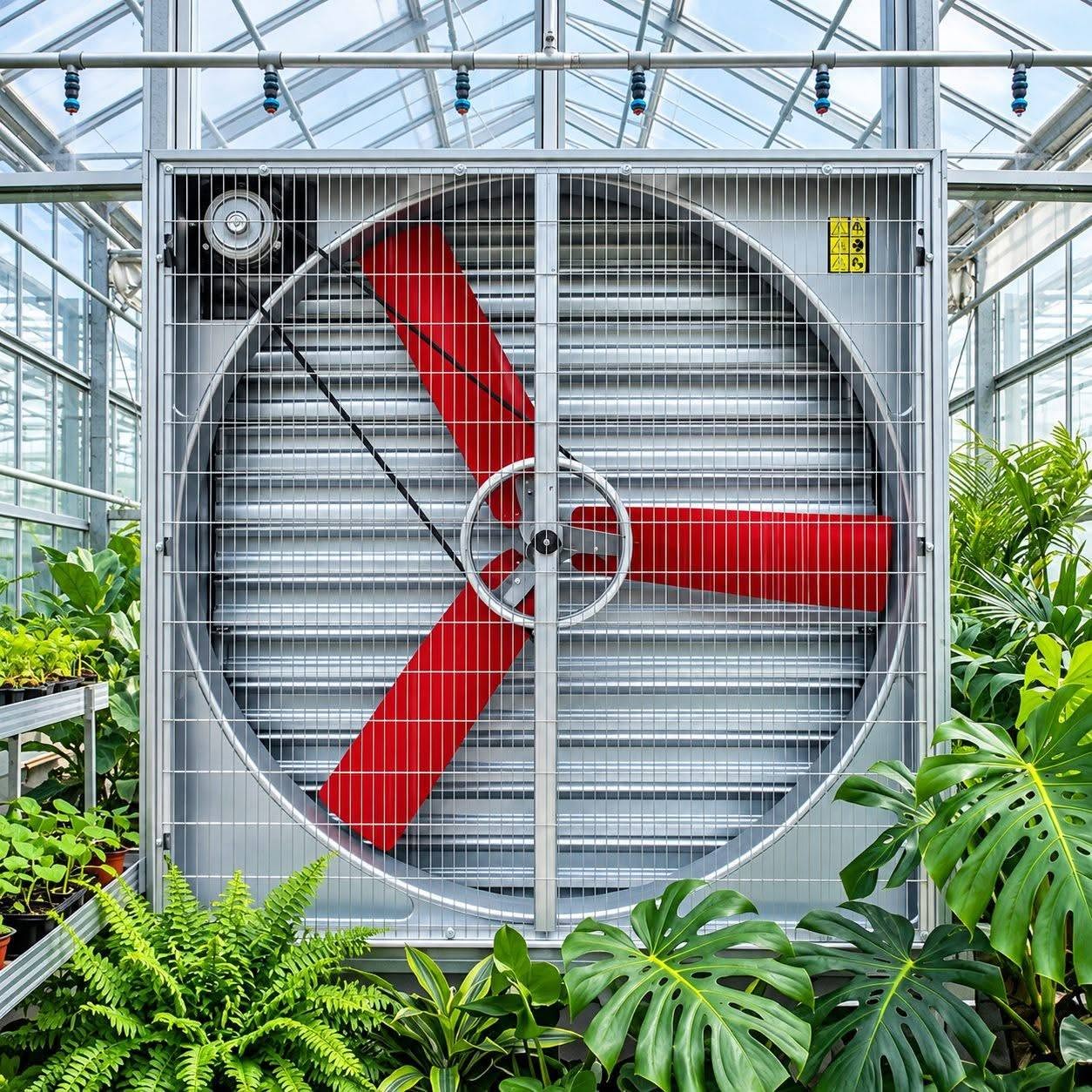
3. Greenhouse Ventilation for Better Crop Growing Conditions
Greenhouses trap solar heat to create conditions that support plant growth. However, excessive temperatures and humidity can damage crops, reduce productivity and encourage certain plant diseases.
Greenhouse ventilation helps remove hot air and regulate the growing environment.
Suitable greenhouse ventilation options
Exhaust and extraction fans: These remove warm air from the greenhouse when appropriately installed with sufficient replacement-air openings.
Circulation fans: These help distribute air within the greenhouse, reducing stagnant areas and supporting more uniform conditions. They do not necessarily remove heat from the building.
Combined ventilation systems: Depending on the greenhouse design and climate, a combination of extraction, circulation, shading and supplementary cooling may be necessary.
When selecting greenhouse fans, consider the crop type, greenhouse dimensions, growing season, humidity, available openings and desired temperature range.
For example, a greenhouse used for leafy vegetables may have different environmental requirements from one growing flowers, seedlings or heat-sensitive crops.
Learn more about our agricultural ventilation fans in Kenya and East Africa and explore options for improving airflow in agricultural buildings.
4. Improving Ventilation in Cow Sheds and Dairy Barns
Dairy cows are sensitive to heat stress, which can affect feed intake, milk production, reproduction and overall welfare. Cow sheds with poor airflow can become particularly uncomfortable during hot weather, when moisture and heat accumulate around the animals.
Industrial circulation fans can help improve air movement around livestock, provided they are installed and sized correctly.
How industrial fans can help dairy farms
- Improve air movement around resting and feeding areas.
- Help cows lose body heat through convection and evaporation when environmental conditions permit.
- Reduce stagnant air in poorly ventilated areas.
- Support a wider heat-management plan that may include shade, drinking water and other cooling measures.
- Improve ventilation when combined with suitable openings and fresh-air supply.
Fan placement matters. Air should reach the areas occupied by the animals rather than simply circulate near the roof.
Where humidity is high, evaporative cooling may be less effective. Misting or sprinkling systems must therefore be selected and managed carefully, with adequate ventilation to avoid increasing indoor humidity unnecessarily.
For larger dairy barns and livestock facilities, fan selection should consider the building layout, herd size, animal comfort requirements and prevailing weather conditions.
5. Controlling Heat in Boiler Rooms and Industrial Production Areas
Boiler rooms, manufacturing plants and process areas may experience intense heat from equipment, hot surfaces, steam lines and industrial operations. Excessive temperatures can create uncomfortable working conditions and may affect equipment operating conditions.
Industrial ventilation can help remove accumulated heat and provide replacement air where required.
Choosing the right ventilation equipment
Axial ventilation fans may be suitable for general air movement and ventilation where system resistance is relatively low.
Centrifugal blowers may be more appropriate when air must travel through ductwork, filters or other components that create significant resistance.
Dedicated heat-extraction systems can be designed to capture heat near its source, reducing the amount that spreads through the building.
The selection process should account for air temperature, required airflow, static pressure, motor suitability, dust or contaminants, and the installation environment.
Boiler rooms also require ventilation designed around combustion-air requirements and applicable safety standards. General-purpose fans must not be treated as a substitute for correctly designed combustion or hazardous-area ventilation systems.
Where equipment produces hot air at a specific point, capturing and removing it close to the source may be more effective than relying entirely on general room ventilation.
Explore our industrial centrifugal fans and blowers for applications requiring ducted airflow or pressure suited to the ventilation system.
6. Reducing Heat in Commercial Kitchens
Commercial kitchens in hotels, restaurants, catering facilities and institutional kitchens can become very hot during busy operating periods. Cooking equipment generates heat, steam, grease-laden air and odours that must be managed by a suitable ventilation system.
A properly designed kitchen ventilation system can improve working conditions and remove contaminants from cooking areas.
Recommended commercial kitchen ventilation measures
- Install an appropriately designed kitchen extraction hood above relevant cooking equipment.
- Use compatible fans and ductwork designed for the required airflow and system resistance.
- Provide sufficient replacement air to support effective extraction.
- Ensure grease management, cleaning access and maintenance arrangements are included in the design.
- Follow applicable fire-safety requirements for grease-laden exhaust systems.
- Assess whether additional general ventilation is needed to control heat elsewhere in the kitchen.
A standard industrial circulation fan cannot replace a properly designed kitchen extraction hood where cooking fumes, grease and contaminants must be captured at source.
For commercial kitchens, restaurants, hotels and catering facilities, explore our commercial kitchen hood system for suitable extraction solutions.
7. How to Choose the Right Industrial Fan for Heat Control
Not every industrial fan performs the same function. Selecting the correct model involves understanding the heat source, the building layout and the airflow needed to achieve the intended result.
Industrial axial fans
Axial fans move air generally parallel to the fan shaft. Depending on the model and installation, they can be suitable for wall-mounted ventilation, general air exchange and moving air through large openings.
Common applications include warehouses, workshops, agricultural buildings and selected industrial ventilation systems.
Centrifugal fans and blowers
Centrifugal fans move air using a rotating impeller and can be suitable for applications where ductwork or other system components create greater resistance.
They are commonly considered for industrial process ventilation, ducted air movement and selected heat-extraction applications.
Air circulation fans
Circulation fans help distribute air around an occupied space. They can be useful in workshops, livestock buildings and other areas where stagnant air is a concern.
However, circulating air within a room is different from extracting hot air and replacing it with fresh air. The appropriate approach depends on the actual problem.
Important factors when sizing industrial fans
Before purchasing a fan, assess:
- Building dimensions: Floor area, ceiling height and the volume of air within the space.
- Heat load: Heat from machinery, sunlight, boilers, cooking equipment, animals or other sources.
- Required airflow: The amount of air that must be moved to meet the ventilation objective.
- Static pressure: Resistance created by ductwork, filters, shutters, hoods and other components.
- Air temperature and contaminants: The fan, motor and materials must be suitable for the operating environment.
- Installation location: Wall, roof, duct, floor or another suitable mounting arrangement.
- Maintenance: Access for cleaning, inspections, repairs and replacement of components.
A fan’s advertised airflow does not necessarily represent the airflow it will deliver after installation. Ductwork, shutters, filters and other resistance can reduce performance. Professional selection helps ensure the equipment suits the application.
Browse our industrial fan range or explore our centrifugal fan and blower options to identify equipment for your project.
8. Why Industrial Fan Installation and Maintenance Matter
Even a high-quality industrial fan may perform poorly if it is incorrectly positioned, undersized or installed without adequate replacement-air openings.
A well-planned ventilation installation should consider the movement of air through the entire building, including where hot air accumulates and where replacement air enters.
Regular maintenance is also important for reliable operation.
Recommended maintenance activities include:
- Inspecting and cleaning fan blades and protective guards.
- Checking motors, bearings, belts and pulleys where applicable.
- Inspecting shutters, dampers and air inlets for obstructions.
- Checking electrical connections and protective devices.
- Monitoring unusual vibration, noise or reduced airflow.
- Confirming that the ventilation system continues to meet operational requirements.
For facilities with heavy dust, moisture or corrosive conditions, equipment specifications and maintenance intervals should reflect the actual operating environment.
9. Industrial Fans and Ventilation Solutions in Kenya, Tanzania and South Sudan
Businesses across East Africa operate warehouses, poultry farms, greenhouses, dairy facilities, factories, commercial kitchens and other buildings where heat management is important.
The Cold Room Kahuna supplies industrial fans and ventilation equipment for a range of applications, helping customers identify options based on their site conditions and operational requirements.
Whether you are improving ventilation in a poultry house, managing heat in a warehouse, installing airflow equipment in a greenhouse or planning a blower for an industrial process, choosing the right equipment is essential.
When enquiring about a ventilation solution, provide the following information where available:
- Your location and type of facility.
- Building length, width and height.
- The main source of heat or ventilation problem.
- Any existing fans, air inlets or ductwork.
- Preferred installation location.
- Available electrical supply.
- Any airflow, temperature or pressure requirements already established.
This information helps determine which fan types and installation arrangements may be suitable for your application.
Contact The Cold Room Kahuna to discuss industrial fan supply and installation for your facility in Kenya, Tanzania, South Sudan and the wider East African region.
Frequently Asked Questions About Industrial Fans and Heat Stress
Can industrial fans reduce heat stress in warehouses?
Industrial fans can help remove accumulated hot air or improve air movement, depending on their type and installation. Their effectiveness depends on the heat load, outside conditions, building design and ventilation arrangement. Where outside air is hotter than the indoor air, bringing it inside may not provide cooling, so the system must be assessed carefully.
Which industrial fan is suitable for a poultry house?
The suitable fan depends on the poultry house dimensions, bird age, stocking density, local climate and required ventilation rate. Correct fan sizing, air inlets and airflow distribution are all important for maintaining appropriate conditions.
Can industrial fans be used in greenhouses?
Yes. Suitable extraction and circulation fans can help manage greenhouse airflow and temperature. The system should be selected according to crop requirements, greenhouse design, humidity and local weather conditions.
Are centrifugal blowers suitable for industrial heat extraction?
Centrifugal blowers can be suitable for applications involving ductwork or higher system resistance, provided the fan’s performance matches the required airflow and static pressure. The operating temperature and nature of the air must also be considered.
How can heat be reduced in a commercial kitchen?
A properly designed kitchen hood and extraction system can capture cooking fumes, steam and heat near their source. Adequate replacement air, suitable ductwork, maintenance and compliance with applicable fire-safety requirements are also essential.
Do industrial fans always lower room temperature?
No. Fans move air, but they do not automatically lower the air temperature. They may improve human comfort or help remove heat when the system is appropriately designed. In some environments, additional cooling, shading, insulation or other heat-control measures may be necessary.
Does The Cold Room Kahuna supply and install industrial fans in Kenya?
The Cold Room Kahuna supplies industrial fans and ventilation equipment and can discuss suitable installation options for commercial, agricultural and industrial projects. Contact the team with your application and location to discuss your requirements.
Get the Right Industrial Fan for Your Facility
Do not let excessive heat and poor air circulation go unaddressed in your warehouse, poultry house, greenhouse, dairy barn, boiler room or commercial kitchen.
The Cold Room Kahuna can help you explore industrial fans, centrifugal blowers and ventilation solutions suited to your application.
Request a quotation for industrial fans and ventilation equipment in Kenya, Tanzania or South Sudan. Share your building dimensions, application and ventilation challenges so the appropriate equipment can be considered.
Visit our industrial fans for sale in Kenya page or explore our centrifugal fans and blowers to get started.
The Cold Room Kahuna — Industrial fan supply and ventilation solutions for Kenya and East Africa.