

Why Proper Fresh Air Intake Is Important in Industrial Buildings, Warehouses and Commercial Kitchens

Industrial ventilation is not just about removing hot air, smoke, dust and unwanted fumes from a building. An effective ventilation system must also provide an adequate supply of fresh outdoor air to replace the air being extracted.

Factories, warehouses, workshops, commercial kitchens and agricultural buildings can experience poor ventilation when extraction fans operate without properly planned replacement-air openings. This can affect airflow, indoor conditions and the overall performance of mechanical ventilation systems.

For businesses in Kenya and across East Africa, proper fresh-air intake is an important consideration when designing, upgrading or maintaining industrial ventilation systems.

Whether you operate a manufacturing facility in Nairobi, a warehouse in Mombasa, a commercial kitchen in Kisumu or an agricultural facility in Tanzania, understanding how fresh-air intake works can help you make better ventilation decisions.

1. What Is Industrial Fresh Air Intake?

Industrial fresh-air intake refers to the controlled introduction of outdoor air into a building through designated openings or mechanical ventilation equipment.

In a mechanically ventilated building, extraction fans remove indoor air and create a pressure difference that encourages replacement air to enter through suitable intake points.

These intake points may include:

  • Industrial air inlet vents.
  • Fresh-air intake louvers.
  • Wall-mounted ventilation openings.
  • Mechanical fresh-air supply fans.
  • Ducted air intake systems.

The appropriate arrangement depends on the building size, ventilation requirements, occupancy, heat sources and type of activities taking place inside.

One important component is the industrial air inlet vent, which provides a designated opening for outdoor air to enter the building.

2. Why Do Industrial Buildings Need Proper Fresh-Air Intake?

Many businesses concentrate on purchasing powerful extraction fans without considering how replacement air will enter the building.

However, extraction and air intake need to work together.

When extraction fans remove large volumes of indoor air, the building needs a suitable replacement-air pathway. If the available intake openings are inadequate, the system may experience excessive negative pressure.

This can contribute to:

  • Reduced extraction airflow.
  • Difficulty opening and closing doors.
  • Uncontrolled air entry through gaps.
  • Uneven air distribution.
  • Poor ventilation performance.
  • Increased demand on mechanical ventilation equipment.

Providing appropriately sized and positioned air intake openings helps ventilation designers develop a more balanced system.

3. Fresh-Air Intake in Factories and Manufacturing Plants

Factories often generate heat, fumes, moisture and airborne contaminants through manufacturing activities and industrial processes.

Welding workshops, fabrication facilities, production plants and processing factories may require dedicated mechanical ventilation systems to remove unwanted indoor air.

Industrial extraction fans and centrifugal blowers can help remove air from designated areas, but sufficient replacement air must also be available.

Fresh-air intake louvers and industrial air inlet vents can provide designated entry points for outdoor air.

For larger manufacturing facilities, the ventilation design should consider:

  • Production equipment and heat-generating machinery.
  • Building dimensions and ceiling height.
  • Required extraction airflow.
  • Location of fresh-air intake openings.
  • Air distribution throughout the working area.
  • Filtration requirements where outdoor air contains dust or other contaminants.

For factories with significant heat or fumes, general ventilation may need to be supplemented with dedicated local exhaust systems.

4. Warehouse Ventilation and Fresh-Air Replacement

Large warehouses can accumulate heat, particularly in buildings with metal roofing, limited ventilation openings and high ceilings.

Storage facilities, distribution centres and industrial warehouses may experience uncomfortable indoor temperatures, especially during hot weather.

A mechanical ventilation system can help remove accumulated indoor heat and introduce replacement outdoor air.

However, installing extraction fans without considering fresh-air intake can limit the effectiveness of the overall arrangement.

Industrial air inlet vents can be installed at suitable positions to provide designated air entry points.

When designing warehouse ventilation, consider:

  • Total floor area and building height.
  • Number and capacity of extraction fans.
  • Position of air intake openings.
  • Heat generated by stored materials and equipment.
  • Outdoor temperature and humidity.
  • Air distribution across the warehouse.

For large warehouses, a professional ventilation assessment is recommended to determine the appropriate number of intake openings and extraction fans.

5. Fresh-Air Intake for Commercial Kitchens and Restaurants

Commercial kitchens depend on effective extraction systems to remove cooking fumes, smoke, grease-laden air and excess heat.

Kitchen extraction hoods are commonly connected to ductwork and extraction fans that discharge indoor air outside the building.

However, the air removed by the extraction system must be replaced.

Without sufficient replacement air, a kitchen may experience negative pressure, which can affect extraction performance and cause difficulties with doors and other building openings.

A properly designed replacement-air system can help address these issues.

Depending on the kitchen design, replacement air may be introduced through:

  • Dedicated fresh-air supply fans.
  • Ducted replacement-air systems.
  • Suitable wall-mounted air inlet louvers.
  • Engineered mechanical ventilation arrangements.

Replacement air should be planned carefully to avoid disturbing the extraction hood’s capture performance or creating uncomfortable draughts around cooking areas.

For commercial kitchens, replacement-air design should account for the extraction hood capacity, kitchen layout, cooking equipment and applicable safety requirements.

6. Workshop, Garage and Automotive Facility Ventilation

Automotive workshops, garages and mechanical service facilities may generate heat, exhaust fumes, dust and airborne contaminants.

Proper ventilation is essential for maintaining suitable indoor working conditions.

Industrial extraction fans can be used to remove unwanted indoor air, while suitable fresh-air intake arrangements provide replacement air.

Workshops with vehicle exhaust emissions or hazardous fumes may require dedicated local extraction equipment rather than relying solely on general ventilation.

Fresh-air intake vents can form part of a broader ventilation arrangement where the outdoor air supply is suitable for the application.

7. Fresh-Air Intake in Poultry Houses and Livestock Buildings

Agricultural buildings have particular ventilation requirements.

Poultry houses, broiler farms, layer houses and livestock facilities need carefully managed air movement to control temperature, moisture and indoor air quality.

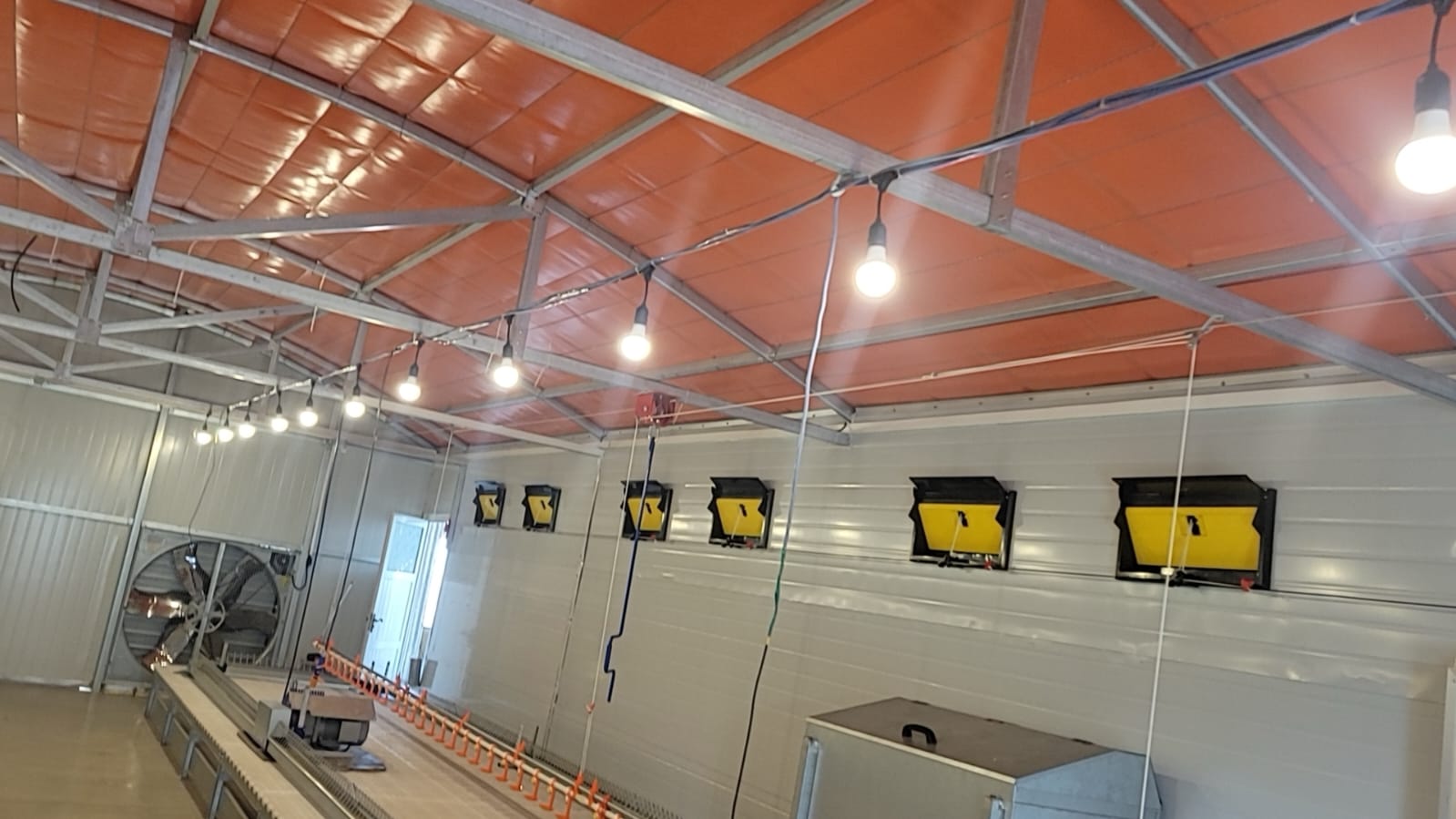
In mechanically ventilated poultry houses, extraction fans remove indoor air while air inlets provide pathways for fresh outdoor air to enter.

The positioning and adjustment of these inlets influence how incoming air moves through the building.

Poorly planned air entry can result in uneven distribution, stagnant areas or unwanted draughts.

For poultry ventilation systems, important considerations include:

  • Poultry house dimensions.
  • Bird age and stocking density.
  • Extraction fan capacity.
  • Number and positioning of air inlets.
  • Required air distribution.
  • Seasonal temperature and humidity conditions.

Manual and automatic air inlet systems are available for different ventilation designs. The correct choice depends on the building, management approach and ventilation requirements.

8. Manual Air Inlet Vents and Adjustable Directional Deflectors

Industrial air inlet vents are available in different designs and operating mechanisms.

Some models use automatic pressure-controlled opening systems, while others operate manually.

A manual air inlet vent allows the user to control the opening without relying on an automatic actuator or pressure-controlled mechanism.

Models featuring adjustable directional deflectors provide additional flexibility in directing incoming air.

This can be useful in ventilation arrangements where the direction of fresh-air entry needs to be adjusted according to the building layout.

For example, a wall-mounted inlet with an adjustable deflector can be incorporated into suitable factory, warehouse, workshop and agricultural ventilation systems.

The selection should consider the required airflow, opening dimensions, installation position and operating requirements.

9. How to Match Air Inlet Vents with Industrial Extraction Fans

An effective mechanical ventilation system requires coordination between air intake and extraction.

The extraction fans determine how much air is removed, while the available intake openings influence how replacement air enters the building.

When selecting equipment, consider the following:

Extraction fan capacity

Determine the required extraction airflow based on building volume, heat loads, occupancy and the nature of the activities inside.

Available intake area

Ensure the air intake openings provide sufficient free area for the required replacement airflow without excessive pressure losses.

Air distribution

Position intake openings to encourage suitable air movement through the occupied or working areas.

Building pressure

Consider the pressure relationship between the building interior and the outdoor environment.

Environmental conditions

Assess outdoor dust, rain exposure, temperature and humidity when selecting intake equipment.

The number of air inlet vents should not be selected simply by matching the number of extraction fans. A proper ventilation design must account for fan airflow, inlet free area, pressure losses and other system requirements.

For ducted ventilation projects and higher-pressure air movement applications, centrifugal blowers may also be appropriate.

10. Choosing the Right Industrial Air Inlet Vent

Before purchasing an air inlet vent, consider the following factors:

1. Material

Choose a material suitable for the installation environment. Plastic/PVC, aluminium and galvanised steel products are available for different applications.

2. Dimensions

Check the outer dimensions and required wall opening to ensure the product fits the intended installation location.

3. Opening mechanism

Determine whether a manual, automatic or motorised opening mechanism is appropriate.

4. Directional airflow

Adjustable directional deflectors can provide flexibility in controlling the direction of incoming air.

5. Environmental protection

Consider whether additional weather protection, insect screening or air filtration is required.

6. Ventilation capacity

Check the effective free area and pressure drop rather than relying on the outer dimensions alone.

11. Industrial Air Inlet Vents Available in Kenya

The Cold Room Kahuna supplies industrial ventilation equipment for factories, warehouses, workshops, commercial kitchens, agricultural buildings and other commercial applications in Kenya.

Our range includes the 600 × 300mm PVC Industrial Air Inlet Vent, featuring:

  • Plastic/PVC construction.
  • Manual opening mechanism.
  • Adjustable directional deflector.
  • Outer dimensions of 600 × 300mm.
  • Specified wall opening of 545 × 260mm.

This wall-mounted fresh-air intake louver provides a designated entry point for outdoor air in compatible mechanical ventilation systems.

Explore our 600 × 300mm PVC Industrial Air Inlet Vent.

We also supply industrial ventilation fans and centrifugal blowers for suitable air extraction and movement applications.

Explore our related products and services:

12. Industrial Ventilation Equipment Supply Across Kenya and East Africa

Choosing the right ventilation equipment is important for factories, warehouses, commercial kitchens, workshops and agricultural facilities.

The Cold Room Kahuna provides industrial ventilation and air movement equipment in Nairobi and across Kenya, with supply solutions for customers in Tanzania, Uganda, Rwanda and South Sudan.

Whether you are improving an existing ventilation system or planning a new project, we can assist with enquiries for suitable air inlet vents, industrial fans and centrifugal blowers.

Contact The Cold Room Kahuna

Phone / WhatsApp: +254 745 105691

Email: info@thecoldroomkahuna.com

Website: https://thecoldroomkahuna.com/

Contact us for industrial air inlet vents, ventilation equipment and fresh-air intake solutions in Kenya and East Africa.

Frequently Asked Questions

What is the purpose of a fresh-air intake vent?

A fresh-air intake vent provides a designated opening for outdoor air to enter a building. It is commonly used alongside mechanical extraction fans to provide replacement air in industrial and commercial ventilation systems.

Why do warehouses need fresh-air intake?

Warehouses may use mechanical extraction to remove accumulated heat and stale air. Fresh-air intake openings provide replacement air and help support the intended airflow through the building.

Can air inlet vents work with industrial extraction fans?

Yes. Air inlet vents can work alongside industrial extraction fans as part of a mechanical ventilation system. Their size, number and position should be selected according to the required airflow and pressure conditions.

What is the difference between manual and automatic air inlet vents?

Manual air inlet vents are operated by hand, while automatic models use mechanisms such as pressure control or actuators to regulate opening. The appropriate option depends on the ventilation design and operating requirements.

Where should industrial air inlet vents be installed?

Their position depends on the building layout, extraction fan locations, airflow requirements and intended air distribution. A ventilation assessment helps determine suitable installation positions.

Where can I buy industrial air inlet vents in Kenya?

The Cold Room Kahuna supplies industrial air inlet vents and ventilation equipment in Kenya. Contact +254 745 105691 for product enquiries, pricing and availability.
Industrial Ventilation Systems and Large Industrial Fans in Kenya and East Africa

Industrial ventilation systems play an important role in factories, warehouses, agricultural facilities, food processing plants and other industrial buildings. They help remove excess heat, extract stale air, control airborne contaminants and maintain suitable airflow for workers, equipment and production processes.

In Kenya and across East Africa, businesses face different ventilation challenges depending on building size, machinery, operating temperatures, dust levels and the nature of their activities. A warehouse may need better air circulation, while a manufacturing plant may require mechanical extraction, ductwork or a high-pressure centrifugal fan.

The Cold Room Kahuna supplies industrial ventilation equipment and provides ventilation installation support for suitable projects across Kenya and East Africa. This guide explains how industrial ventilation systems work, the industries that use them and how to select the right solution for your facility.

What Is an Industrial Ventilation System?

An industrial ventilation system uses fans, air inlets, ductwork and other equipment to move air through a building or industrial process.

Depending on the application, the system may introduce fresh air, remove hot air, extract fumes, control dust or improve air distribution across a large indoor space.

A properly selected ventilation system can help:

  • Remove accumulated heat from production areas.
  • Improve air movement in large buildings.
  • Extract stale air, smoke and certain airborne contaminants.
  • Support suitable temperature and humidity management.
  • Improve working conditions around machinery and production equipment.
  • Support the ventilation requirements of agricultural facilities.
  • Reduce the buildup of unwanted airborne pollutants when the system is correctly designed.

The equipment must match the intended application. General air circulation, industrial exhaust extraction and hazardous fume removal require different approaches.

Types of Industrial Ventilation Equipment

1. Industrial Axial Fans

Axial fans move air in a direction broadly parallel to the fan shaft. They are commonly used where substantial airflow is needed without excessive system resistance.

Typical applications include factory ventilation, warehouses, poultry houses, greenhouses, workshops and agricultural buildings.

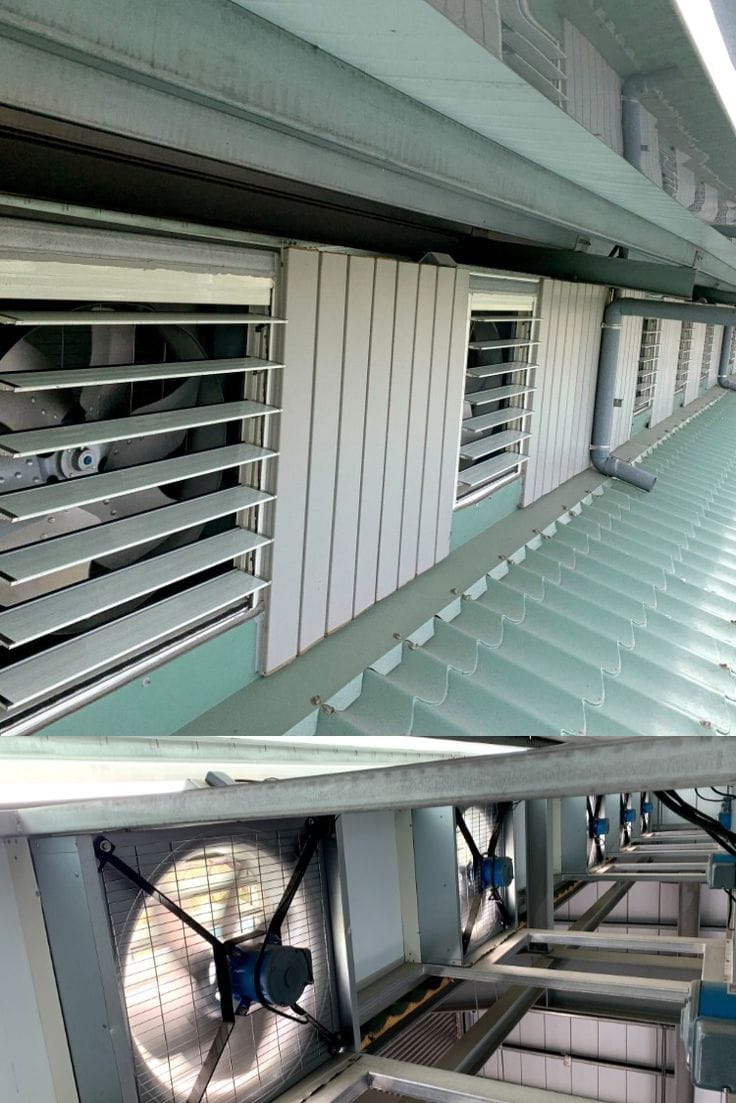
Wall-mounted exhaust fans can remove indoor air directly outdoors, while suitable axial fans can supply fresh air or circulate air through designated openings.

Explore our industrial fans for sale in Kenya for available equipment options.

2. Industrial Centrifugal Fans and Blowers

Centrifugal fans use a rotating impeller to move air through a fan housing. Depending on the design, they can deliver the pressure needed for ducted systems and other applications with greater airflow resistance.

Typical applications include industrial air extraction, dust collection, filtration systems and process air supply.

The correct model depends on the required airflow, static pressure, air temperature and properties of the material being handled.

Read our guide to high-air-volume versus high-pressure centrifugal blowers to understand the difference.

3. Industrial Exhaust Fans

Exhaust fans remove unwanted indoor air and discharge it outside. They are useful in facilities where heat, moisture, odours or stale air accumulate.

Applications include workshops, warehouses, factories, agricultural buildings and suitable commercial kitchens.

Effective exhaust ventilation also requires a suitable route for replacement air to enter the building. Without adequate air intake, fan performance may be reduced.

4. Ductwork and Mechanical Ventilation

Ductwork distributes or extracts air between designated locations. It allows ventilation equipment to serve specific work areas, machinery, rooms or production processes.

A complete mechanical ventilation installation may include fans, ducts, grilles, dampers, filters, supports and electrical controls.

Explore our ductwork fabrication and mechanical ventilation services in Kenya for more information.

Industries That Use Industrial Ventilation Systems

1. Manufacturing and Processing Plants

Manufacturing facilities may generate heat, dust, fumes and airborne particles during production.

Industrial ventilation can remove unwanted air from selected work areas, improve general air circulation and support the operating requirements of machinery.

Metal fabrication, plastic processing, woodworking and other manufacturing operations may require different fan types and extraction arrangements.

Where fumes or hazardous substances are present, the ventilation system should be designed specifically for those contaminants.

2. Warehouses and Distribution Centres

Large warehouses can experience heat buildup beneath metal roofs, particularly when natural ventilation is limited.

Industrial exhaust fans help remove hot indoor air, while air circulation fans distribute air across work areas.

The best arrangement depends on the warehouse layout, roof height, heat sources, available air inlets and the required airflow.

For large facilities, several strategically positioned fans may provide better coverage than a single fan installed without an airflow assessment.

3. Poultry Farms and Livestock Buildings

Ventilation is essential in poultry houses, dairy facilities and livestock barns. These buildings may require continuous air exchange to help manage heat, moisture and gases produced by animals and their surroundings.

Suitable industrial fans can support air movement and help remove stale air. Poultry ventilation systems must also account for stocking density, bird age, outside conditions and the required ventilation rate.

For livestock barns and cow sheds, the fan arrangement should provide appropriate airflow without creating unsuitable drafts or leaving poorly ventilated areas.

4. Greenhouses and Agricultural Facilities

Greenhouses can overheat when solar heat accumulates and natural ventilation is insufficient.

Exhaust fans and appropriately positioned air inlets can help remove hot air and support temperature management. Circulation fans can also reduce stagnant air and improve airflow distribution within the growing area.

Fan selection should consider greenhouse dimensions, crop requirements, humidity, shading and the availability of replacement air.

5. Food Processing and Cold Storage

Food processing plants often need ventilation to manage heat, moisture and air movement around production equipment.

Cold rooms and freezers, however, require a different approach. Their evaporator fans circulate refrigerated air within the insulated space, while the refrigeration system removes heat.

General industrial ventilation fans should not be treated as a substitute for the refrigeration equipment needed to maintain cold room temperatures.

The appropriate solution depends on whether the requirement is general factory ventilation, process extraction or temperature-controlled storage.

6. Mining, Cement and Heavy Industry

Mining and cement operations can produce substantial dust, heat and other airborne contaminants.

Industrial fans may be used for ventilation, process air, dust extraction and filtration, depending on the facility’s requirements.

Cement plants may require heavy-duty centrifugal fans to overcome system resistance in ductwork, filters and process equipment.

Underground mines and hazardous industrial areas require specialist ventilation engineering and equipment suitable for the relevant gases, dust, temperatures and operating conditions.

7. Power Generation and Hydropower Facilities

Power generation facilities contain equipment that can release considerable heat during operation.

Ventilation may be required in turbine halls, generator rooms, electrical rooms and auxiliary equipment spaces.

The system must account for the heat generated, equipment operating limits, air quality and the building layout. Depending on the application, industrial fans may work alongside dedicated air conditioning or equipment-cooling systems.

8. Automotive Workshops and Paint Facilities

Vehicle workshops may accumulate engine heat, exhaust gases, fumes and airborne particles.

Mechanical ventilation can help remove contaminated air from designated work areas and improve general air movement.

Spray-painting facilities require specially designed extraction and filtration systems. Fans and electrical components must be appropriate for the relevant flammable vapours and applicable safety requirements.

A standard industrial fan should not be used as a substitute for a properly specified hazardous-area ventilation system.

9. Data Centres and Electrical Rooms

Data centres, server rooms and electrical equipment rooms require reliable temperature management.

Industrial fans can support air circulation or remove heat in suitable applications, but they do not replace the dedicated cooling systems required by many server environments.

Where precise temperature control and continuous operation are essential, the ventilation arrangement must be coordinated with the air conditioning system, equipment heat load and room airflow design.

10. Textile and Garment Factories

Textile production can generate heat, fibres, lint and dust.

Ventilation and extraction systems can help manage airborne material and improve airflow around production equipment.

The fan, ductwork and filtration arrangement should be selected for the type of fibre or dust involved. Where combustible dust may be present, specialist engineering and appropriate safety measures are essential.

11. Chemical and Pharmaceutical Facilities

Chemical and pharmaceutical operations may require controlled ventilation to manage heat, humidity, odours, vapours or airborne contaminants.

Some facilities also require specific pressure relationships, filtration or cleanroom air-handling systems.

The correct equipment depends on the process, chemical properties, required air changes and applicable safety standards. General-purpose ventilation fans are not suitable for every chemical or pharmaceutical application.

How to Choose the Right Industrial Ventilation System

Before purchasing industrial fans or planning a ventilation installation, assess the following factors.

Required Airflow

Determine how much air must be supplied, circulated or extracted. Airflow is commonly expressed in cubic metres per hour (m³/h).

The required airflow depends on the building, process, heat load, occupancy and ventilation objectives.

Static Pressure

Static pressure is important when air must pass through ductwork, filters, bends, dampers or other restrictive components.

Axial fans may be suitable for many low-resistance applications, while centrifugal fans are often selected where higher pressure is needed.

Always select equipment using its performance data at the required operating point.

Installation Location

Consider whether the fan will be wall-mounted, roof-mounted, suspended, installed inside ductwork or connected to industrial equipment.

The building structure, weather exposure, access for maintenance and location of air inlets and outlets all affect the installation.

Air Quality and Operating Conditions

Specify whether the system will handle clean air, dust, fumes, moisture, high temperatures or corrosive substances.

These conditions affect the required fan construction, materials, filtration and safety features.

Electrical Requirements

Check the motor power, voltage, phase, frequency and control requirements. Ensure that the available electrical supply is compatible with the selected equipment.

Energy Consumption and Maintenance

Choose a fan that meets the required duty without unnecessary oversizing. Proper fan selection, duct design and regular maintenance can help reduce energy waste and maintain performance.

Industrial Ventilation Supply and Installation in Kenya and East Africa

The Cold Room Kahuna supplies industrial ventilation equipment and provides installation support for suitable projects across Kenya and the wider East African region.

Our ventilation solutions can include:

  • Industrial axial and exhaust fans
  • Centrifugal fans and blowers
  • Industrial air extraction equipment
  • Mechanical ventilation and ductwork
  • Factory and warehouse ventilation
  • Agricultural and poultry house ventilation
  • Air circulation solutions for suitable industrial buildings

We support customers in Kenya and projects serving Uganda, Tanzania, Rwanda and South Sudan, subject to project scope and delivery arrangements.

For a quotation, provide the facility type, building dimensions, intended application, required airflow if known, electrical supply and installation location. Photographs, existing fan nameplates and duct measurements can also help with equipment selection.

Explore our industrial ventilation fan options or contact The Cold Room Kahuna through our contact page to discuss your project.

Frequently Asked Questions

What is the main purpose of an industrial ventilation system?

An industrial ventilation system moves air to help remove excess heat, stale air and certain airborne contaminants, or to provide fresh air where needed. The system must be designed for the specific building and application.

Which industrial fan is best for a warehouse?

The choice depends on the warehouse size, ceiling height, heat sources, airflow requirements and available air openings. Exhaust fans can remove hot air, while circulation fans help distribute air within the building.

What is the difference between an axial fan and a centrifugal fan?

An axial fan moves air broadly parallel to its shaft and is commonly used for high airflow in suitable low-resistance applications. A centrifugal fan directs air outward through an impeller housing and is often selected for systems requiring greater static pressure.

Can industrial ventilation fans be used in poultry houses and cow barns?

Yes. Suitable fans can support ventilation in poultry houses, dairy buildings and livestock barns. The installation must provide the required air exchange and account for animal density, building layout and environmental conditions.

Do industrial fans replace air conditioning?

No. Industrial fans move air and may improve ventilation or perceived comfort, but they do not necessarily lower the actual indoor temperature. Air conditioning is needed where controlled cooling and temperature management are required.

Do you supply and install industrial ventilation systems in Kenya?

The Cold Room Kahuna supplies industrial ventilation equipment and provides installation support for suitable projects. Contact us with your application details to discuss equipment selection, availability and a quotation.

Conclusion

Industrial ventilation systems help businesses manage heat, air movement and airborne contaminants across a wide range of industries. The right solution may involve exhaust fans, axial fans, centrifugal blowers, ductwork or a combination of equipment selected for the facility’s requirements.

For industrial ventilation equipment and installation support in Kenya and East Africa, The Cold Room Kahuna can help you identify a suitable solution for your factory, warehouse, agricultural facility or industrial project.

Proper ventilation is critical in factories, warehouses, and commercial spaces to maintain air quality, control temperature, and ensure worker safety. One of the most effective solutions is the  centrifugal fan (blower) known for its ability to move large volumes of air at high pressure .

In this guide, we walk you through the step-by-step process of centrifugal fan installation in Kenya, helping you achieve efficient and long-lasting industrial ventilation.

What is a Centrifugal Fan?

A centrifugal fan is a mechanical device that uses rotating impellers to increase air pressure and move air through ducts or ventilation systems.

Key Benefits:

  • High air pressure for ducted systems
  • Suitable for industrial and commercial ventilation
  • Handles heat, dust, and fumes effectively
  • Durable for continuous operation

Applications in Kenya

Centrifugal fans are widely used in:

  • Factories – removing heat, fumes, and dust
  • Warehouses – improving airflow and temperature control
  • Commercial buildings – ventilation for kitchens, basements, and HVAC systems
  • Agricultural setups – drying and air circulation

Tools & Equipment Required

Before installation, ensure you have:

  • Mounting brackets or base frame
  • Ducting (GI or flexible ducts)
  • Fasteners (bolts, nuts, anchors)
  • Electrical wiring & control panel
  • Vibration isolators
  • Safety gear (gloves, helmet)

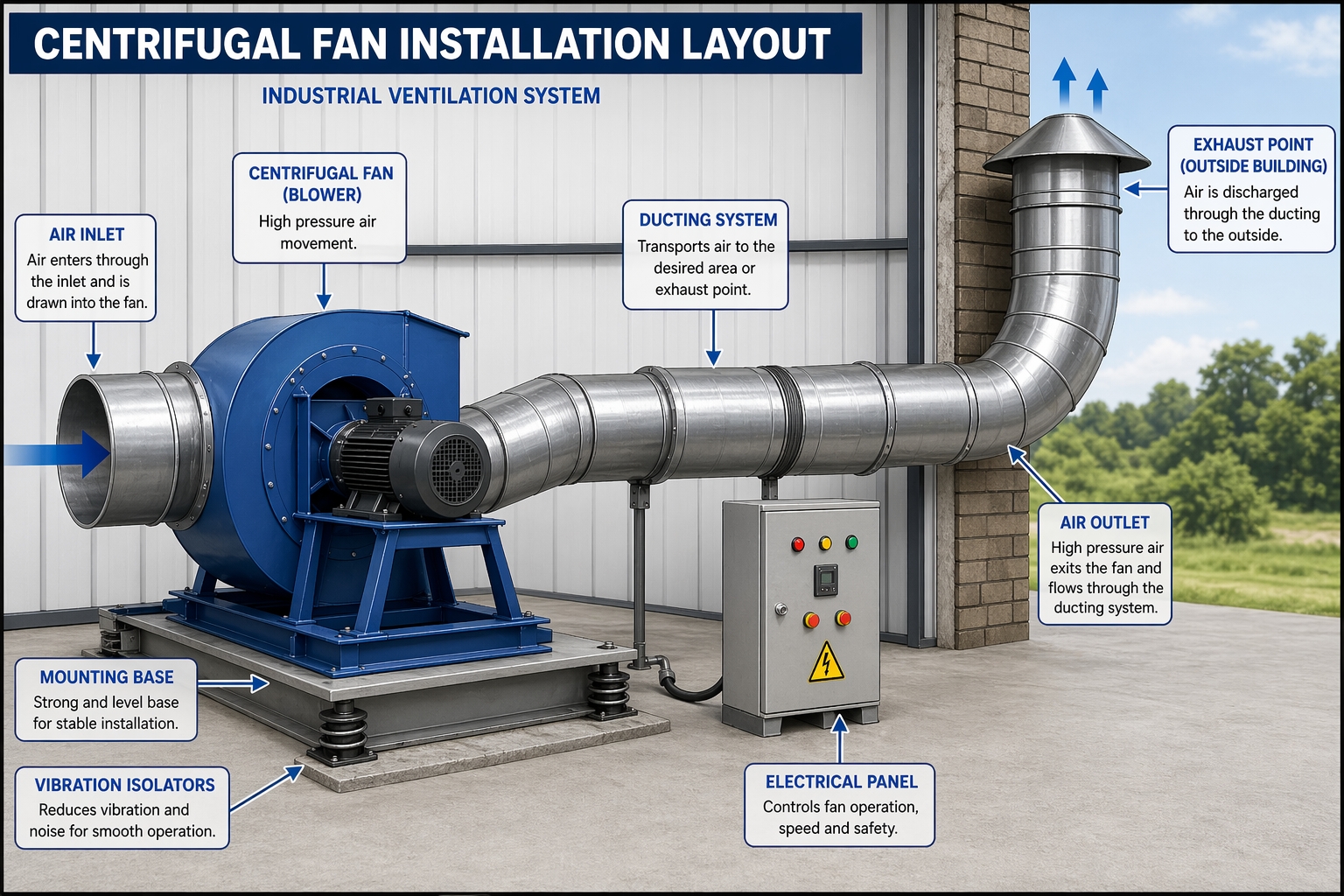
Step-by-Step Centrifugal Fan Installation

Step 1: Site Assessment & Planning

  • Evaluate airflow requirements (CFM)
  • Identify installation location (roof, wall, or floor-mounted)
  • Plan duct routing and outlet direction

👉 Tip: Poor planning leads to airflow loss and inefficiency.

Step 2: Prepare the Mounting Base

  • Install a solid and level base frame
  • Use anti-vibration pads to reduce noise and wear
  • Ensure the structure can support the fan weight

Step 3: Position the Centrifugal Fan

  • Place the fan correctly according to airflow direction
  • Align inlet and outlet with ducting system
  • Secure firmly using bolts and anchors

Step 4: Install Ductwork

  • Connect ducts to fan inlet and outlet
  • Seal all joints to prevent air leakage
  • Use proper duct sizing to maintain airflow efficiency

Step 5: Electrical Connections

  • Connect to a suitable power supply (single or three-phase)
  • Install control panel or starter
  • Ensure proper grounding and protection

⚠️ Always use a qualified technician for electrical work.

Step 6: Test Run & Inspection

  • Run the fan and check for:
    • Noise and vibration
    • Airflow direction and volume
    • Electrical stability
  • Adjust alignment if necessary

Step 7: Final Optimization

  • Balance airflow within the system
  • Install dampers if needed
  • Train operators on usage and maintenance

Common Installation Mistakes to Avoid

  • Incorrect fan sizing
  • Poor duct design
  • Lack of vibration control
  • Improper electrical connections
  • Ignoring airflow direction

Maintenance Tips for Long-Term Performance

  • Regularly clean fan blades and ducts
  • Check bearings and lubrication
  • Inspect electrical connections
  • Monitor noise and vibration

Why Professional Installation Matters in Kenya

Industrial environments in Kenya often face:

  • High temperatures
  • Dust-heavy conditions
  • Continuous operation demands

Professional installation ensures:

  • Maximum efficiency
  • Longer equipment lifespan
  • Compliance with safety standards

Conclusion

Installing a centrifugal fan correctly is essential for achieving efficient ventilation in factories, warehouses, and commercial setups. By following this step-by-step guide, businesses can improve air quality, reduce heat buildup, and enhance productivity.

error: Content is protected !!
Talk to Us